
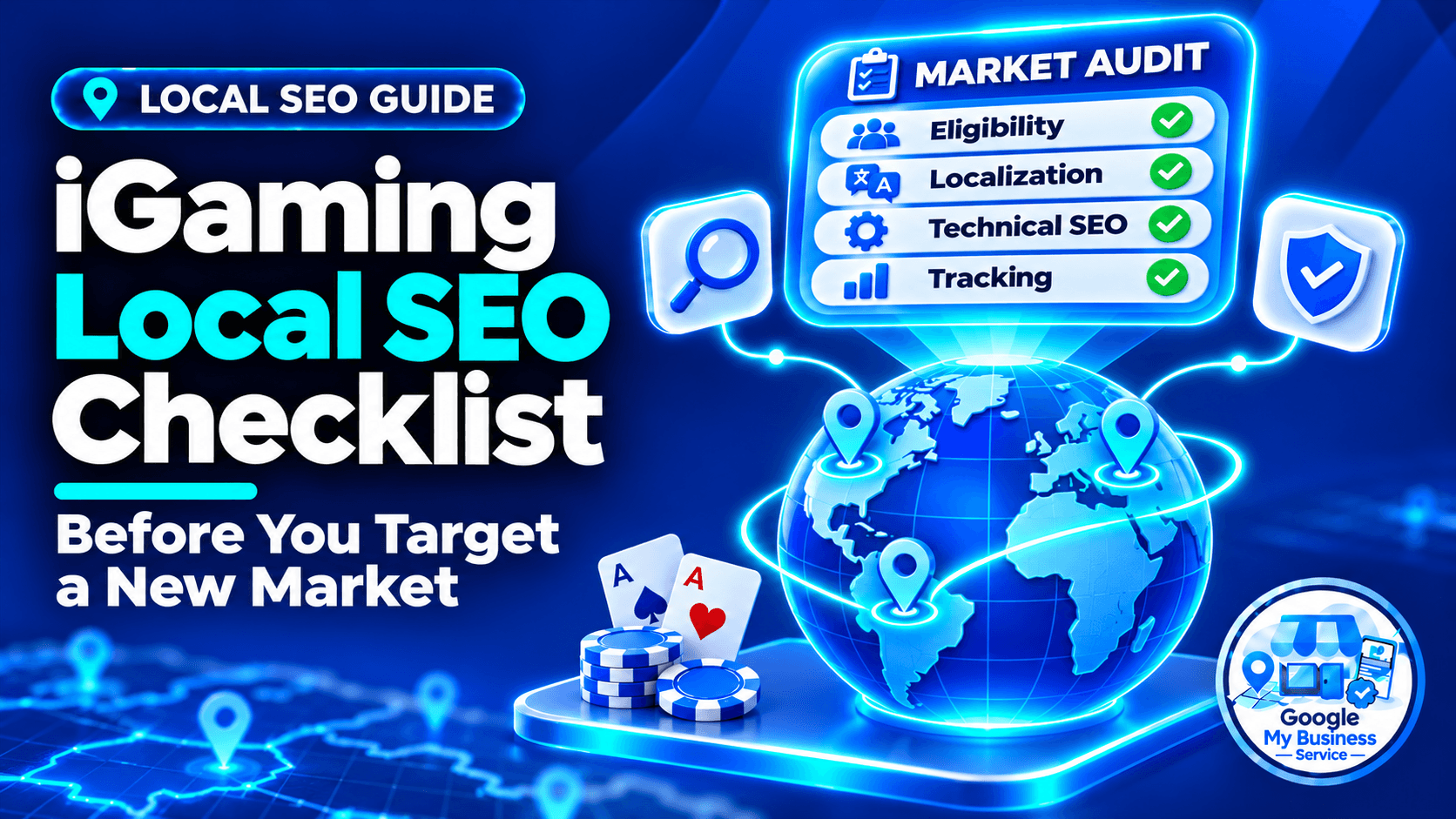
A new market needs more than a translated homepage and a list of regional keywords. Before investing in content or links, confirm that the business can serve the intended audience, that its pages describe the right offer, and that customers and search engines can reach the information they need.
This iGaming local SEO checklist gives operators, affiliates and physical gaming venues a practical audit to complete before expansion. It separates market-entry decisions from routine optimization and helps you record evidence, assign responsibility and resolve the issues that matter first. For businesses with genuine customer-facing locations, use it alongside our general local SEO checklist.
Key takeaways
- Identify the business model and exact jurisdiction before planning pages.
- Verify permission, product availability and required disclosures for that market.
- Research local search intent instead of assuming translations will perform alike.
- Check architecture, rendering, regional access, mobile experience and measurement.
- Treat Google Business Profile eligibility as a separate physical-business check.
- Record evidence and owners; unresolved launch blockers outweigh completed minor tasks.
What does iGaming local SEO mean?
In iGaming, local SEO refers to targeting specific legal jurisdictions, states, or countries where an operator or affiliate is explicitly licensed and authorized to serve players, rather than physical neighborhoods or brick-and-mortar storefronts.
That definition describes the online market-targeting use of the term. Licensing and authorization requirements differ by activity and jurisdiction, so it should not be read as a universal requirement for every affiliate to hold an operator license. Physical casinos and betting venues have a separate local search need: helping customers find a real, eligible location. An online operator, an affiliate publisher and a venue therefore require different audit paths.
| Business model | Main audit focus | Google Business Profile approach |
|---|---|---|
| Online operator | Permitted markets, actual product availability, localized content and website access | An online-only operation does not qualify simply because it targets a region |
| Affiliate or review publisher | Permitted promotion, operator information, transparent comparisons and disclosures | An online-only publication does not qualify merely by covering local operators |
| Customer-facing physical venue | Location accuracy, venue information, website quality and applicable market requirements | Assess the real business against Google’s eligibility rules |
| Hybrid brand | Online-market requirements plus each genuine venue’s customer journey | Assess physical locations individually; the online brand does not create extra locations |
| B2B supplier | Business-buyer intent, product scope, support and relevant markets | Review its actual operations individually; an office address alone is insufficient |
What should you audit before entering a new market?
Audit permissions, business identity, search demand, localized content, site architecture, technical access, mobile usability, trust, relevant references and measurement. Start with issues that could invalidate the launch or mislead customers. For every check, record the market, page or profile inspected, evidence, result, responsible team and next action rather than relying on a completion percentage alone.
Create one record for each combination of market, product and business model. Include the trading brand, legal entity, proposed URLs, languages, source documents and review date. A country name by itself is too broad when permissions or offers vary within that country. Use the table below as a working record and add actual names and deadlines for your team.
| Audit check | Evidence to retain | Suggested owner | Priority if unresolved |
|---|---|---|---|
| 1. Market permission and product scope | Current authorization evidence and reviewer decision | Compliance/legal | Launch blocker |
| 2. Business identity and GBP eligibility | Entity record; eligibility rationale if a profile is proposed | Operations/profile manager | Block incorrect claims or profile creation |
| 3. Regional search intent | Dated SERP sample and keyword-to-page map | SEO/content | High |
| 4. Localized offer and language | Reviewed page, payment/support details and disclosures | Product/local editor | Block materially misleading offers |
| 5. Architecture and locale signals | URL map, canonical and alternate-page checks | SEO/development | High |
| 6. Crawlability and access | Response/indexing evidence and rendered-page checks | Development/SEO | Block inaccessible essential pages |
| 7. Mobile experience | Journey tests and available performance data | Development/UX | Block broken essential journeys |
| 8. Trust and editorial quality | Sources, review methodology and correction owner | Editorial/compliance | High; block misleading claims |
| 9. Markup and answer clarity | Visible-content comparison and validation results | SEO/development | High if misleading; otherwise planned improvement |
| 10. References and listings | Reviewed links/listings and correction record | PR/operations | High for false identity details |
| 11. Measurement | Baseline, tested events and reporting definitions | Analytics/product | Establish before launch |
| 12. Maintenance | Named owners, review dates and withdrawal process | Project lead | Establish before launch |
These priorities are a suggested operating framework, not Google’s ranking formula. A technically perfect page can still describe an unavailable product. Equally, a properly authorized business can launch a page that search engines cannot index. Both require attention, but the fixes and accountable teams are different.
1. Confirm the market, activity and authorization
Start with the exact activity being promoted and the entity responsible for it. Record whether the project concerns an operator, affiliate, supplier or physical venue, then identify the relevant jurisdiction and product. Do not assume a license associated with one entity, brand or territory covers another. The audit should record a qualified review of the applicable requirements before expansion proceeds.
Ask the responsible compliance reviewer to confirm:
- Which entity and trading brand the permission covers.
- Which products and audience locations are included or excluded.
- Whether affiliate promotion, advertising or disclosures require separate treatment.
- Which age restrictions, terms and responsible gambling information apply.
- What happens when permission, a partnership or an offer changes.
Save the source, review date and decision in the market record. This checklist does not establish whether a particular business may operate in a named country. Language demand, search visibility, payment availability and a foreign license are not substitutes for that decision. Organic-search eligibility, paid-ad permission and GBP eligibility must also be evaluated separately.
2. Check business identity and Google Business Profile eligibility
Verify that the company name, trading brand, contact details and proposed location accurately describe the business. If the plan includes a Business Profile, check eligibility before creating or expanding listings. Google’s eligibility guidelines generally require in-person customer contact during stated hours and explicitly list online-only businesses as ineligible.
For an eligible physical venue, check the recognized name, address, hours, website and existing listing before proposing changes. Do not manufacture locations to target cities. Read our Google Maps SEO guide for the physical-location workstream and our guide to choosing GBP categories for accurate representation. A selected category or an existing map listing does not itself establish eligibility.
3. Research search intent in the actual target market
Search from the relevant market and language, recording the date, query and context. An operator may compete with comparison publishers for some terms and with other operators for others. Inspect the result type before choosing a page format. A transactional landing page, a comparison article and a venue page answer different questions, even when their keywords overlap.
Build a small intent map:
| Query pattern | Likely reader need to verify | Suitable content direction |
|---|---|---|
[brand] + [market] | Availability, identity and official information | Accurate brand/market page |
+ [jurisdiction] | Market-specific options and requirements | Useful market/product page |
[payment method] + | Whether a method is actually supported | Verified availability and conditions |
[venue name] + opening hours | Practical visit information | Genuine venue page/profile |
[operator] review + [market] | An independent assessment and limitations | Transparent review with disclosed methodology |
Ahrefs or Semrush can help expand terms and estimate demand; existing Search Console queries can reveal how current pages are found. Treat tool estimates as estimates. A long phrase is not automatically easy to rank for. Keep only terms that fit the permitted activity, available product and page purpose, and document the strongest competing results for each important group.
4. Audit localization beyond translation
A translated headline is not evidence that a page fits the market. Ask a competent local-language reviewer to assess the search phrasing, terminology and clarity of the whole journey. Check navigation, support information, currency, payment methods, availability and the terms customers see after clicking. The localized version should remain accurate when the visitor reaches the next step.
For example, a page may mention a familiar payment method while the product does not support it for the intended audience. That is a product-information failure, not something to fix by adding more keywords. Record the approved source for each material claim. Publish a language version because it serves a real audience with a supported offer, rather than because a competitor lists several languages.
5. Review landing pages, canonical URLs and hreflang
Use a page structure that makes the market and product understandable. A dedicated market page should provide distinct information that helps its intended visitor, such as applicable availability, language or support details. Before creating another URL, ask what decision that page improves. Replacing a country or city name across otherwise identical pages adds little practical value.
Audit the URL map for overlapping pages, orphan pages and conflicting canonical targets. Canonical annotations indicate a preferred version among duplicate or very similar pages; they are signals, not guarantees. Do not point a genuinely useful market page at an unrelated global page by default. Compare the declared preference with Google’s selected canonical where data is available. See Google’s canonicalization guidance.
For language/country variants, check valid codes and reciprocal references against Google’s localized-version guidance. en-US represents English for the United States; hreflang does not provide US-state targeting. Do not invent en-US-NJ as a New Jersey value. State pages need useful state-specific information and clear navigation. Hreflang is also not a permission control or a replacement for content quality.
6. Test crawling, rendering and regional access
Choose representative market pages and inspect whether the intended content can be discovered and indexed. Check response behavior, robots directives, internal links and the rendered page in appropriate diagnostic tools. Essential information should not disappear because a template, script or access layer returns an empty shell. Google’s JavaScript SEO guide explains the distinction between crawling, rendering and indexing.
Test public information and restricted product functionality separately. Age gates, login requirements, regional access rules and CDN protections can affect the experience. Record what a permitted visitor and relevant diagnostic tools can access. Do not disable required restrictions, cloak promotional content for crawlers or assume every gate must be removed for SEO. Compliance and development should agree on an accessible, accurate public-information design that preserves required controls.
7. Check mobile usability and page performance
Test the actual journey on representative phones, including navigation, language choice, important disclosures, contact routes and any permitted next step. Look for overlays that hide information, buttons that move, unreadable text and broken forms. A fast homepage does not prove that every market template works. Record the device, page, problem and reproduction steps so the developer can act on the finding.
Use available real-user evidence alongside diagnostic tests. Google’s Core Web Vitals guidance covers loading, responsiveness and visual stability through LCP, INP and CLS. Good performance supports the experience; it does not guarantee rankings. When a new page has insufficient field data, retain lab findings as diagnostic evidence and review real-user results when enough data becomes available.
8. Verify trust information and content quality
Review the facts a visitor relies on before deciding whether to trust the business. Confirm the entity identity, material product conditions, contact routes, applicable license information and responsible gambling resources with the appropriate reviewer. A trust page should be consistent with the market page and the real service. Decorative badges, vague claims and copied disclosures do not replace accurate information.
For affiliate reviews, explain the commercial relationship, comparison criteria and information sources. Describe direct testing only when it actually happened, with evidence of the method and its limits. Add an author or organizational byline that readers can understand, and assign a correction owner. Google’s people-first content guidance emphasizes useful original value and trustworthy presentation rather than a preferred word count.
Build supporting content around real unresolved questions: availability, support, terms, identity and practical venue information where relevant. Link those pages so readers can follow the evidence. Avoid manufacturing a large cluster of near-identical reviews simply to make the site appear comprehensive. Content depth means answering the necessary questions accurately, not publishing the largest number of pages.
9. Check structured data and answer clarity
Compare structured data with the visible page and the supported feature’s current requirements. The marked-up business, article or other entity must match what readers can verify. Fix fake ratings, unsupported claims and mismatched details. Google’s structured data guidelines explain that valid markup does not guarantee a rich result; technical validation alone does not establish compliance with every quality rule.
For AI-assisted discovery, make the market, business model, evidence and limitations clear in ordinary text. Google states that AI Overviews and AI Mode require no special schema. As of this article’s review, its documentation changelog also records the discontinuation of FAQ rich results. Keep FAQs because they help readers, and use our AI search optimization guide for the wider context. Citation or inclusion is never guaranteed.
10. Review relevant references, links and listings
Check whether external references describe the correct brand, activity and market. Prioritize genuine editorial relevance and useful referral opportunities over a fixed link quantity, authority score or monthly-traffic cutoff. Review sponsored relationships and link treatment with your SEO lead. Google’s spam policies address manipulative linking and pages created to funnel similar regional searches without sufficient value.
For physical venues, use our local citations guide to compare important listings against a confirmed master record. Correct wrong phone numbers, outdated addresses and misleading identities first. For online-only businesses, focus on accurate corporate and industry references instead of inventing a local address. Neither directory submissions nor a list of city names creates a genuine physical presence.
11. Establish measurement before changing the market pages
Record the baseline before launch: relevant queries, landing-page performance, current audience locations and tested website outcomes where data exists. Agree on what counts as an outcome for the business model. A click, a successful form, a validated enquiry and an approved registration are different events. Measure the action that actually occurred rather than labeling every interaction as a customer.
Use Search Console and GA4 alongside appropriate business records. Country-level search reporting is not a precise state-level compliance check, and analytics location should not determine legal eligibility. For eligible venues, our GBP traffic and lead tracking guide covers the profile-to-website journey. Keep that attribution separate from general organic traffic, and avoid adding campaign tags to ordinary internal navigation.
12. Assign owners and decide whether the market is ready
Give each material issue a responsible person, evidence link, next action and due date. Set a review process for changing permissions, product availability, disclosures, partnerships, broken pages and tracking failures. A checklist becomes useful when the team can explain why a check passed and who will notice if it stops passing. Schedule reviews around material changes as well as routine maintenance.
Use ready, ready with tracked improvements, or hold as operational decisions. Hold expansion when permission is unresolved, material claims are wrong or essential journeys fail. Lesser improvements can be assigned after the responsible team confirms they do not invalidate launch. These labels describe your internal review, not an assurance of regulatory compliance, indexing or search performance.
What does a completed market audit look like?
A completed audit connects evidence to a decision. It identifies the market and business model, separates blockers from improvements, assigns owners and records what will be checked again. The example below shows the method for a fictional operator. It is not a client case study, a legal determination or evidence of a ranking increase.
| Finding | Evidence recorded | Owner and action | Decision impact |
|---|---|---|---|
| Proposed market scope is not signed off | Permission review remains unresolved | Compliance reviewer confirms scope | Hold expansion |
| Localized page advertises an unavailable payment method | Product availability record contradicts copy | Product/editor correct claim and retest | Hold affected offer |
| Developer proposed a state-specific hreflang value | Implementation specification contains an unsupported value | SEO/development correct locale plan | High-priority technical correction |
| Online-only business has no customer-facing venue | Operations confirms business model | Remove GBP creation from the project scope | Continue website work after other blockers clear |
| Analytics records button clicks as completed enquiries | Event test shows no successful submission required | Analytics corrects event definition | Fix baseline before evaluating results |
After correction, the same team revisits the evidence and records a new decision. The point is not to make every cell green on the first attempt. It is to prevent content, technical work and reporting from moving forward on incompatible assumptions. Keep the history so a later reviewer can see what changed and why.
Frequently asked questions
No. For online businesses, the term commonly describes regional organic-search targeting. Google Maps SEO concerns the visibility of eligible real-world businesses and locations. A hybrid brand may need both, but a country landing page does not create another physical venue, and an online license does not by itself establish Business Profile eligibility.
Google lists online-only businesses as ineligible for Business Profiles. A corporate registration or rented mailing address does not change that by itself. A genuine customer-facing venue needs a separate assessment against all applicable rules. Plan regional website visibility and physical-location visibility as distinct workstreams rather than assuming every market needs another map listing.
Create a separate page when it serves a distinct, supported audience need and can provide useful information for that market. Availability, terms, language and venue details may justify separate pages. Changing only the place name is a weak basis for expansion. Start with a clear page map and assess overlapping intent before adding URLs.
No. Hreflang identifies supported language and optional country or region variants; it does not encode individual US states. Use useful state-specific pages and clear internal navigation where appropriate. Do not invent state codes in hreflang or treat locale annotations as geofencing, legal authorization or a mechanism that guarantees regional rankings.
No. Clear answers, useful evidence and an accessible website can support discovery, but Google decides which sources appear for each query. Special schema is not required for AI Overviews. Evaluate whether the page helps the intended reader complete an audit, then monitor search visibility and real outcomes without promising control over an AI-generated answer.
Complete it before expansion and revisit affected checks whenever permissions, product availability, partnerships, website behavior or material information changes. Set a routine review appropriate to the business, with named owners for urgent corrections. Technical observations and ranking data need context over time; a single good test or search position does not establish continuing readiness.
Turn the audit into a clear next action
Start with the market record, identify the most consequential unresolved issue and assign it to the person who can fix it. Once the launch conditions are sound, improve the pages, navigation and evidence that help customers understand the business. A useful iGaming local SEO plan connects these decisions instead of treating rankings as a substitute for readiness.
Google My Business Service provides GBP setup and optimization support. If your gaming business has a genuinely eligible customer-facing location, explore our iGaming Google Business Profile setup service. For an eligible active profile you already control, review our Google Business Profile optimization service. Choose the scope that matches your actual profile needs; broader website SEO and market-authorization review remain separate workstreams.